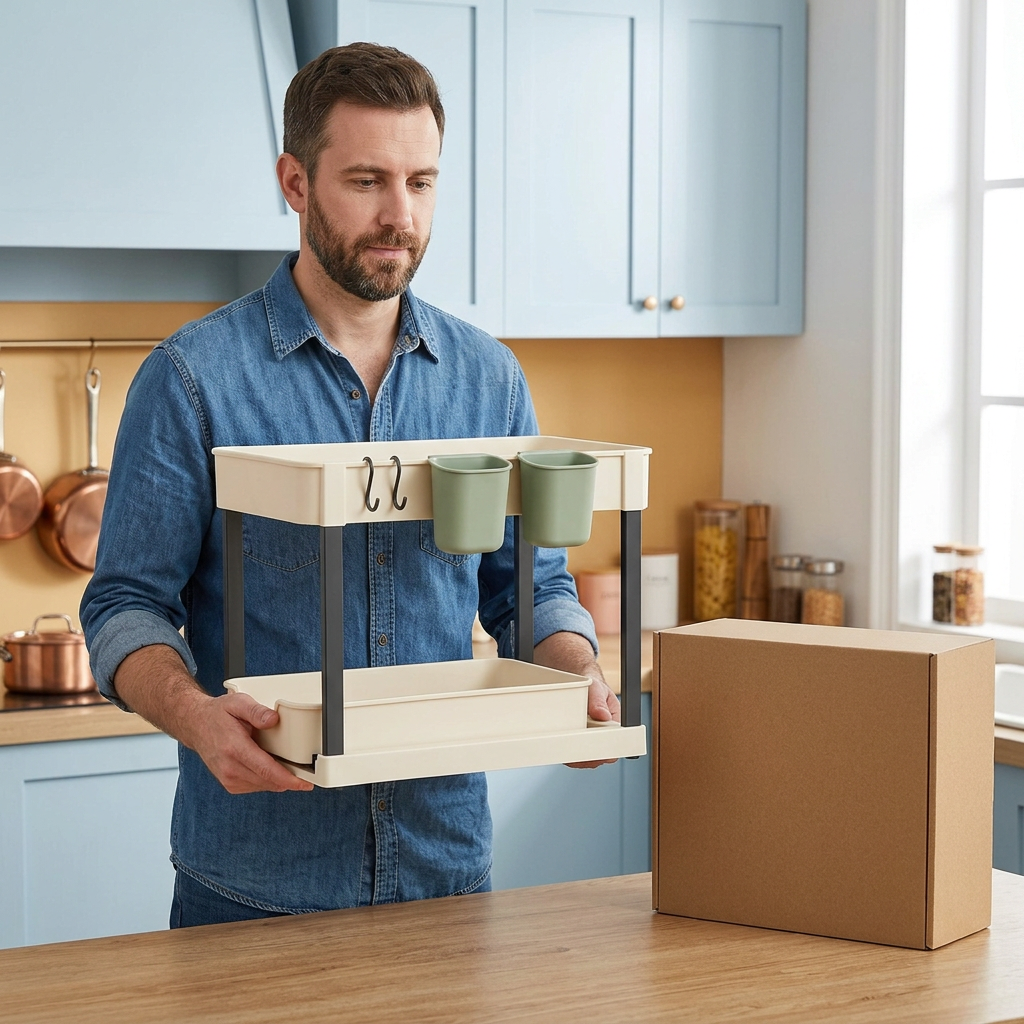
Two-Tier Under-Sink Organizer with Pull-Out Lower Tray, Sage Hanging Cups and Hooks for Thoughtful Cabinet Storage
Two-Tier Under-Sink Organizer with Pull-Out Lower Tray, Sage Hanging Cups and Hooks for Thoughtful Cabinet Storage
📢Try it now and if it doesn't work, we guarantee a full refund!
✅ 30-Day Returns
✅ Natural ingredients for fast, long-lasting results
✅ Long-standing service to the London Early Years Foundation
⚡ Stock is limited and will sell out soon!
Couldn't load pickup availability
🚪 Open the cabinet. Change the way you reach.
A cabinet can look full long before it is usefully organized. A small brush disappears behind a larger object. Supplies gather in a single row that becomes several rows. Each time you reach toward the back, something at the front has to move first.
This two-tier under-sink organizer concept begins with that everyday movement. Not simply where an item sits, but how you find it, lift it out, and put it back. Ivory trays create two visual levels, charcoal uprights frame the structure, and sage hanging cups introduce a separate place for smaller pieces. The pictured lower tray extends forward on runners, suggesting a different approach to accessing the lower section.
One cabinet, three different kinds of space
The upper surface: a place to recognize the regulars
Plan the upper area around suitable items you identify at a glance. Keep categories clear rather than filling every gap. A visible arrangement is most useful when you can remove one object without disturbing its neighbors.
What belongs here depends on the finished product's confirmed load guidance and the available cabinet clearance. Do not assume a heavy container is appropriate simply because the tray appears to accommodate it.
The lower tray: think about access, not just placement
The concept imagery shows a lower tray partly extended beyond the supporting frame. That visual idea focuses on bringing a section toward the cabinet opening rather than reaching around everything in front of it.
Actual movement, extension limits, stability, and any securing requirements must be verified on the supplier's product. A photograph cannot establish a tested sliding mechanism or safe use under load.
The outer edge: a separate home for the small pieces
Two sage cups and two charcoal S-shaped hooks are pictured along the upper tray edge. They create a visual distinction between the main storage areas and the smaller items that tend to disappear among them.
Use the idea to plan categories, not to assume unlimited hanging capacity. The finished attachments and their intended uses need confirmation before choosing what to place in or hang from them.
🧭 Start with the reach you repeat most often.
Consider the last time you opened the cabinet. What were you looking for? What did you move first? Which item was difficult to see, and what did you leave out because returning it felt inconvenient?
Those small observations are a better starting point than arranging everything by appearance alone. Put frequently used categories where access is comfortable. Keep occasional supplies separate. Leave room to see what you already have before buying more.
The objective is not to turn a practical cabinet into a display that cannot be touched. It is to make the next ordinary task feel less interrupted.
A calmer palette for a hardworking corner
The ivory trays have rounded-looking corners and slotted bases in the proposed design. Dark uprights provide a clear outline, while the sage cups add a muted green accent. Together, the colors create a softer alternative to a visually crowded collection of unrelated containers.
In the imagery, the palette works against terracotta, pale blue, warm wood, and lavender. These settings illustrate possible styling directions. They do not establish compatibility with every cabinet or suitability for a wet environment.
The packaging follows the same restrained approach: a plain kraft-style box with no printed branding, words, or decorative marks.
A practical cabinet reset, without the guessing
- Review what is already there. Separate the items you regularly use from things that belong elsewhere.
- Inspect the setting. Check the cabinet floor and surrounding area. Storage should not hide a leak, obstruct maintenance access, or press against plumbing.
- Confirm the actual product instructions. Review the supplied assembly method, stability guidance, movement limits, and intended loading before arranging contents.
- Plan clear categories. Choose a purpose for each level and each accessory rather than filling spaces at random.
- Check the full movement path. Make sure doors, hinges, pipes, and neighboring objects do not obstruct the organizer or its moving tray.
- Return items with the next use in mind. Keep the system simple enough to maintain after a busy day.
Picture the end of an ordinary evening
The kitchen is nearly finished for the night. You open the cupboard for a familiar household tool, recognize its category, and return it to the same place when you are done. Nothing needs to be balanced against another object. You do not leave a small item on the counter because its storage place has disappeared beneath a pile.
That is the routine this concept is intended to support: a clear place to look, an understandable way to group belongings, and a layout that considers the act of putting them back.
Close-up details, explained honestly
The detail views focus on the visible lower runner, the slotted tray surface, the charcoal upright connections, and the hanging accessories. They show the proposed appearance of the parts rather than verified manufacturing specifications.
Slots in a tray do not establish drainage performance or moisture resistance. A dark frame does not establish a particular metal or corrosion-resistant finish. A runner visible in an image does not prove a tested cycle life, quiet operation, or a safe load limit. Those are product facts to confirm with the supplier, not promises to infer from styling.
🪴 Keep the system useful after the first tidy-up.
Give each category some breathing room. If a group consistently overflows, reconsider what belongs in the cabinet instead of forcing more onto the organizer. Review duplicates before adding new supplies, and keep necessary information on household product packaging readable.
Use a suitable dry storage environment and follow each stored item's own instructions. An organizer is not spill containment, a drying appliance, or a child-safety device. Cleaning chemicals require appropriate storage, and an accessible-looking layout does not make hazardous substances safe to leave within reach of children or pets.
Before choosing the finished product
Will it work around every sink pipe?
No universal cabinet or plumbing compatibility has been verified. The depicted settings are examples only. Check the actual organizer against your cabinet layout, plumbing, door movement, and maintenance-access needs before purchase.
Does it require assembly or securing?
The assembly process and any securing requirements remain subject to supplier confirmation. Do not assume the organizer is ready to use without setup or can safely operate unsecured.
Is it waterproof, rustproof, or dishwasher safe?
These properties have not been established. Material composition, surface treatment, cleaning methods, and suitability near moisture must be confirmed on the actual supplied item.
How much can the trays, cups, and hooks hold?
Tested capacities are not available for this concept. Follow the supplier's separate guidance for the whole unit, individual levels, moving tray, cups, and hooks. Avoid assuming that accessory pieces share the same limits as the main trays.
About the images and proposed configuration
This draft uses AI-generated concept imagery, not verified photographs of stocked goods. The intended configuration is one two-tier organizer with ivory trays, charcoal uprights, a sliding lower section, two sage hanging cups, two hooks, and unbranded packaging. Final contents, materials, construction, accessory attachment, assembly instructions, movement limits, care guidance, and load ratings must be checked against the supplier's actual product before sale. Minor visual variations may occur between concept images.
Cabinetry, sinks, plumbing, furniture, kitchen tools, and decorative items in the scenes are styling elements and are not included components of the proposed set.
Make the hidden corner easier to understand.
A better cabinet does not need to hold more of everything. It needs a clearer relationship between what you keep and how you use it. Start with your most familiar routine, separate the categories that keep becoming mixed, and leave room for comfortable access.
Behind a closed door, a thoughtful arrangement can still make a difference every time you open it.

Two-Tier Under-Sink Organizer with Pull-Out Lower Tray, Sage Hanging Cups and Hooks for Thoughtful Cabinet Storage